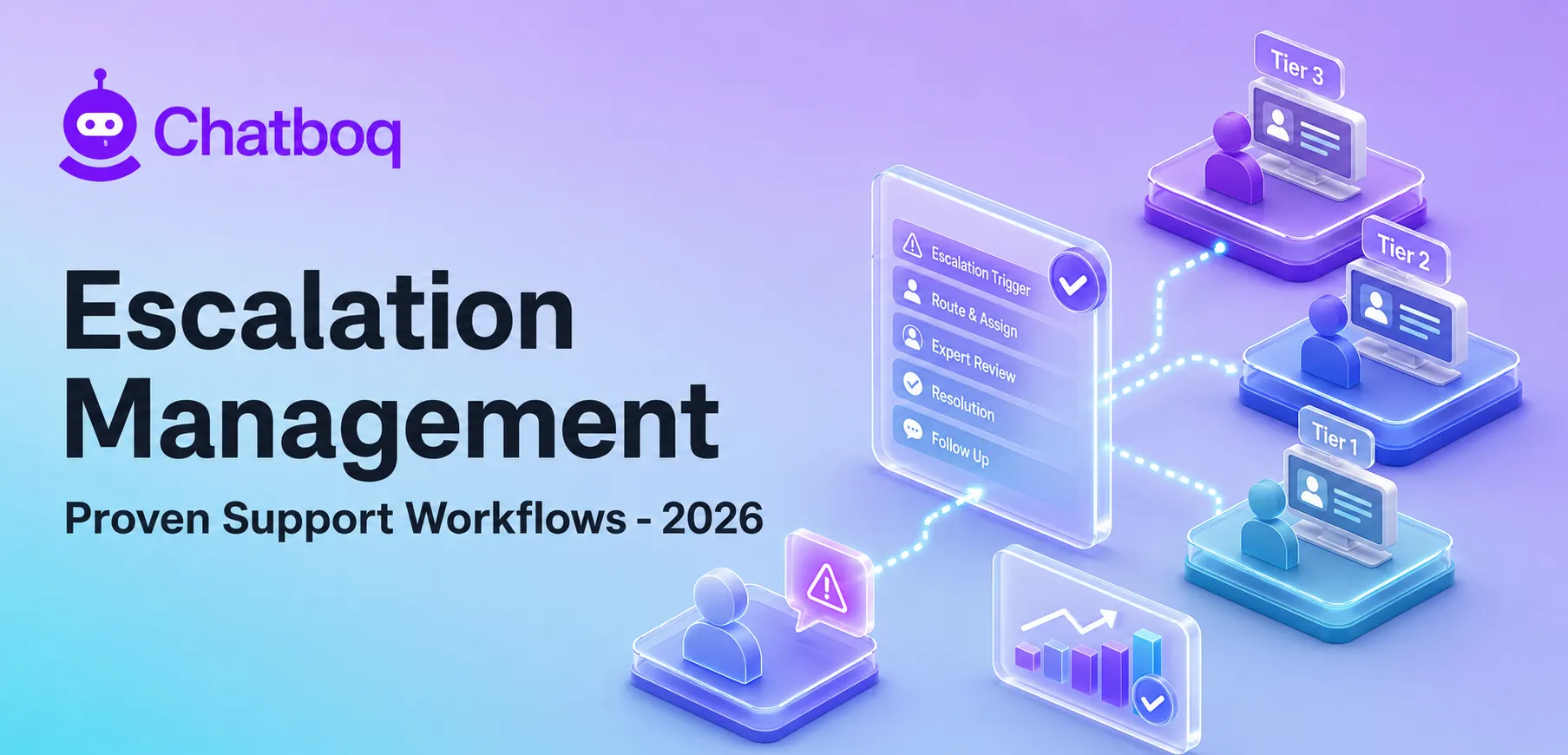
Chatbots and AI improve escalation management by detecting escalation signals in real time before agents identify them manually, routing complex issues to the appropriate support tier without human routing decisions, providing receiving agents with complete customer context before they begin resolution, and reducing overall escalation volume by resolving more issues at the initial contact stage.
Detecting Escalation Signals
AI systems detect escalation signals in customer communication using 3 analytical capabilities: sentiment analysis identifies frustration, urgency, and complaint language in message text, intent detection identifies cancellation intent, legal threats, and formal complaint signals, and conversation analysis identifies repeated contact patterns by matching current tickets against the customer's prior interaction history in the CRM. Human agents identify escalation signals inconsistently under high ticket volume conditions.
An agent handling 40 tickets per day may correctly identify escalation signals 80% of the time in a controlled test environment but 55 to 60% of the time under actual workload conditions. AI detection applies identical signal criteria to every incoming message simultaneously, regardless of agent workload or fatigue. According to IBM's 2023 AI in Customer Service Report, AI sentiment detection identifies escalation-risk conversations 73% faster than manual agent identification on average across the customer service operations studied.
Routing Complex Issues to Agents
AI-powered intelligent routing in escalation management directs support escalation tickets to the most suitable support agent or specialist team based on issue type, historical resolution data, CRM context, and agent capacity within the support workflow system. Standard routing rules assign tickets based on keyword matching or category tags. Intelligent routing uses the full ticket content, customer history, and resolution outcome data from similar prior escalations to match each escalated ticket to the agent whose expertise and capacity profile best fits the case.
A technical escalation involving a specific integration type routes to the agent with the most successful resolution history for that integration, not simply to the next available Tier 2 agent. Intelligent routing reduces misassignment rates for escalated tickets by 28 to 35% compared to keyword-based routing rules, according to Zendesk's 2023 AI Feature Benchmark data, reducing the handling time lost when escalations route to agents without the relevant expertise.
Supporting Agents with Context and Data
AI systems provide agents receiving escalated tickets with a pre-compiled context summary that includes the customer's full interaction history, the escalation signals detected, the resolution steps already attempted, and suggested resolution approaches based on similar closed escalations in the knowledge base. This context summary replaces the manual ticket history review that agents currently perform at the start of each escalated case. A context summary generated by AI in 30 seconds replaces 10 to 20 minutes of manual history reconstruction.
CRM integration enables the AI system to include customer account data, purchase history, subscription tier, and prior escalation outcomes in the context summary alongside the current ticket data. Agents with complete context at the start of resolution spend their allocated time on resolution rather than on information gathering, improving resolution speed and quality simultaneously.
Reducing Escalation Volume
A chatbot that successfully resolves a technical troubleshooting request prevents the ticket from entering the agent queue and potentially reaching an escalation threshold. Chatbot resolution capability in escalation management depends on knowledge base quality and integration with CRM software, support ticket history, and customer account data, allowing AI chatbot systems to resolve low-complexity customer issues before escalation to support agents.
Escalation volume reduction through chatbot resolution complements escalation management by resolving low-complexity customer support tickets before they reach escalation triggers. It reduces the volume of cases that reach escalation thresholds, enabling the escalation management process to operate at higher quality with existing specialist team capacity.

 ChatGPT
 Perplexity
 Claude



Leave a Comment
Your email address will not be published. Required fields are marked *
By submitting, you agree to receive helpful messages from Chatboq about your request. We do not sell data.