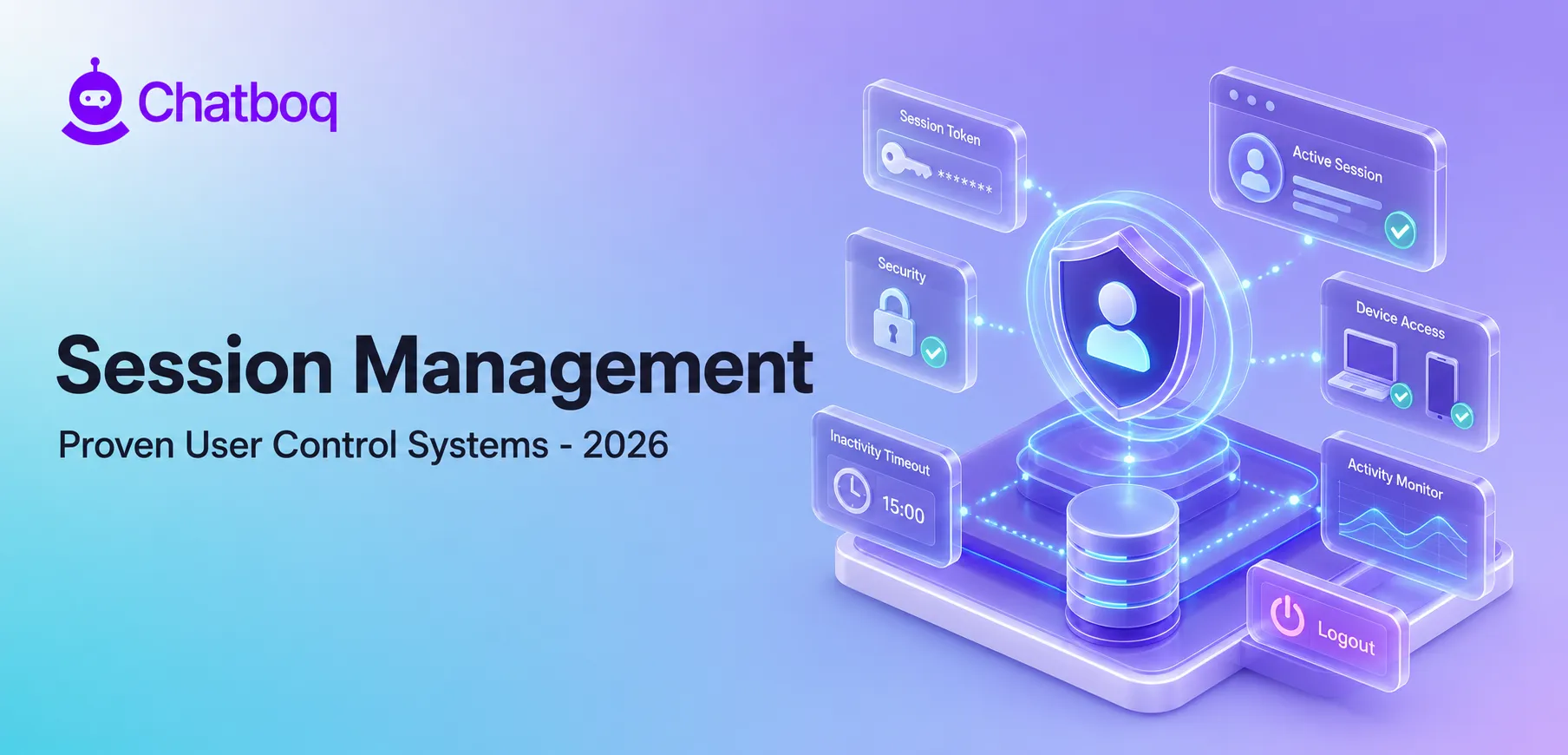
AI improves session management by detecting suspicious session behavior automatically, adapting authentication requirements based on behavioral patterns, maintaining conversation context across extended support interactions, and optimizing session continuity through intelligent workflow coordination.
AI Detects Suspicious Session Behavior and Security Anomalies
AI-powered session monitoring analyzes active session behavior against established user baselines to detect anomalies indicating unauthorized access. Behavioral patterns monitored include: login location (flagging access from unexpected geographies), device fingerprint (detecting new or unrecognized devices), request frequency (identifying automated scraping or credential stuffing patterns), navigation sequence (detecting bot-like access patterns that differ from human browsing), and time-of-access patterns (flagging access outside the user's normal activity window).
When behavioral analytics identify anomaly combinations exceeding the risk threshold , typically three or more concurrent signals , the system triggers adaptive authentication: requiring step-up verification before session continuation. AI anomaly detection reduces unauthorized session access incidents by 41% compared to rule-based threshold systems, according to IBM's Cost of a Data Breach Report 2023.
Behavioral Analytics Improve Adaptive Authentication Workflows
Adaptive authentication adjusts the authentication requirement in real time based on the risk level of the current session context. Low-risk sessions, recognized device, normal location, standard access patterns, proceed without additional verification. High-risk sessions , new devices, unusual location, atypical behavior, require step-up authentication: a second factor such as an SMS code, authenticator app approval, or biometric confirmation.
Behavioral analytics build the risk model by tracking six session attributes per user: typical access times, geographic patterns, device inventory, navigation sequences, request volume, and feature usage. Adaptive authentication reduces friction for legitimate users while increasing security requirements for anomalous sessions, a superior balance compared to static multi-factor authentication that applies identical friction to all sessions regardless of risk.
Conversational AI Maintains Context Across Live Support Interactions
Conversational AI systems use session management to maintain contextual memory across multi-turn support interactions. Each message in a conversation references the session record , retrieving prior exchanges, customer identity, and issue context before generating a response. Session-aware conversational AI avoids repeating questions already answered, references prior statements accurately, and tracks conversation progress toward resolution. Session context storage for conversational AI contains three operational data types: structured data (customer identity, account status, issue category), unstructured data (conversation transcript), and inference data (AI-generated classifications: sentiment, intent, escalation probability). Conversational AI without session context treats each message as an independent query , producing responses that ignore prior conversation and require customers to repeat information, reducing resolution rates and increasing escalations.
Intelligent Automation Optimizes Session Continuity and Workflow Coordination
Intelligent automation manages session continuity events , expiration warnings, renewal prompts, inactivity detection, and cross-device synchronization, without requiring manual system administration. Automated session renewal presents users with continuation prompts before session expiration rather than terminating sessions mid-workflow. Automated inactivity detection logs out inactive sessions after the defined timeout period, freeing session storage resources and reducing the exposure window for abandoned authenticated sessions.
Workflow coordination automation routes in-progress tasks (incomplete forms, pending transactions, open support tickets) to the next session when a user re-authenticates after session expiration, preventing workflow loss without extending session duration beyond security policy limits. These automations reduce session management support tickets by handling expiration and renewal events transparently.

 ChatGPT
 Perplexity
 Claude



Leave a Comment
Your email address will not be published. Required fields are marked *
By submitting, you agree to receive helpful messages from Chatboq about your request. We do not sell data.