

A renewal sequence usually needs an advance notice, a reminder close to the date and a follow-up after, each with a different purpose.
Advance notice
The first message should arrive far enough ahead that a member has time to act, which in most memberships means several weeks rather than several days.
This is also the message that satisfies any obligation to notify before an automatic charge, which makes its timing partly a compliance question.
The reminder near the date
A second message shortly before renewal catches members who intended to act and did not, which is a substantial proportion of the total.
This one should be short and action-focused, since its job is to prompt rather than to inform.
After the date
A follow-up after a lapse or a failed payment recovers members who did not realise anything had happened, which is common with expired cards.
Sending this promptly matters, since a member who has been without access for a week has begun adjusting to its absence.
Card expiry as a separate trigger
A card expiring before the renewal date is a predictable failure that can be prevented entirely by asking for updated details in advance.
This single automation removes a meaningful share of involuntary churn and requires only a date comparison.
Aligning with the billing system
Reminders must fire relative to the actual charge date held in the billing platform rather than an approximation, since a message arriving after the charge is worse than none.
Time zone handling matters here too, because a reminder intended for the day before can land on the day itself for members in other regions.
 ChatGPT
 Perplexity
 Claude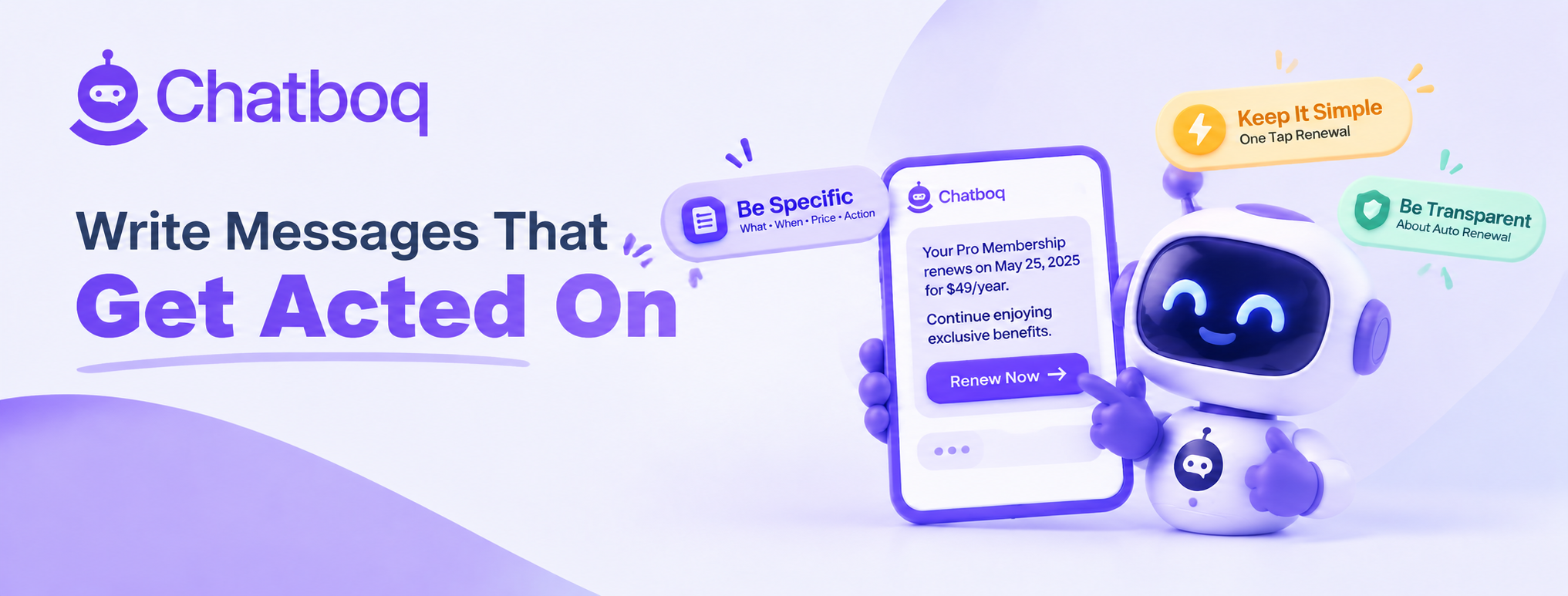





Leave a Comment
Your email address will not be published. Required fields are marked *
By submitting, you agree to receive helpful messages from Chatboq about your request. We do not sell data.