
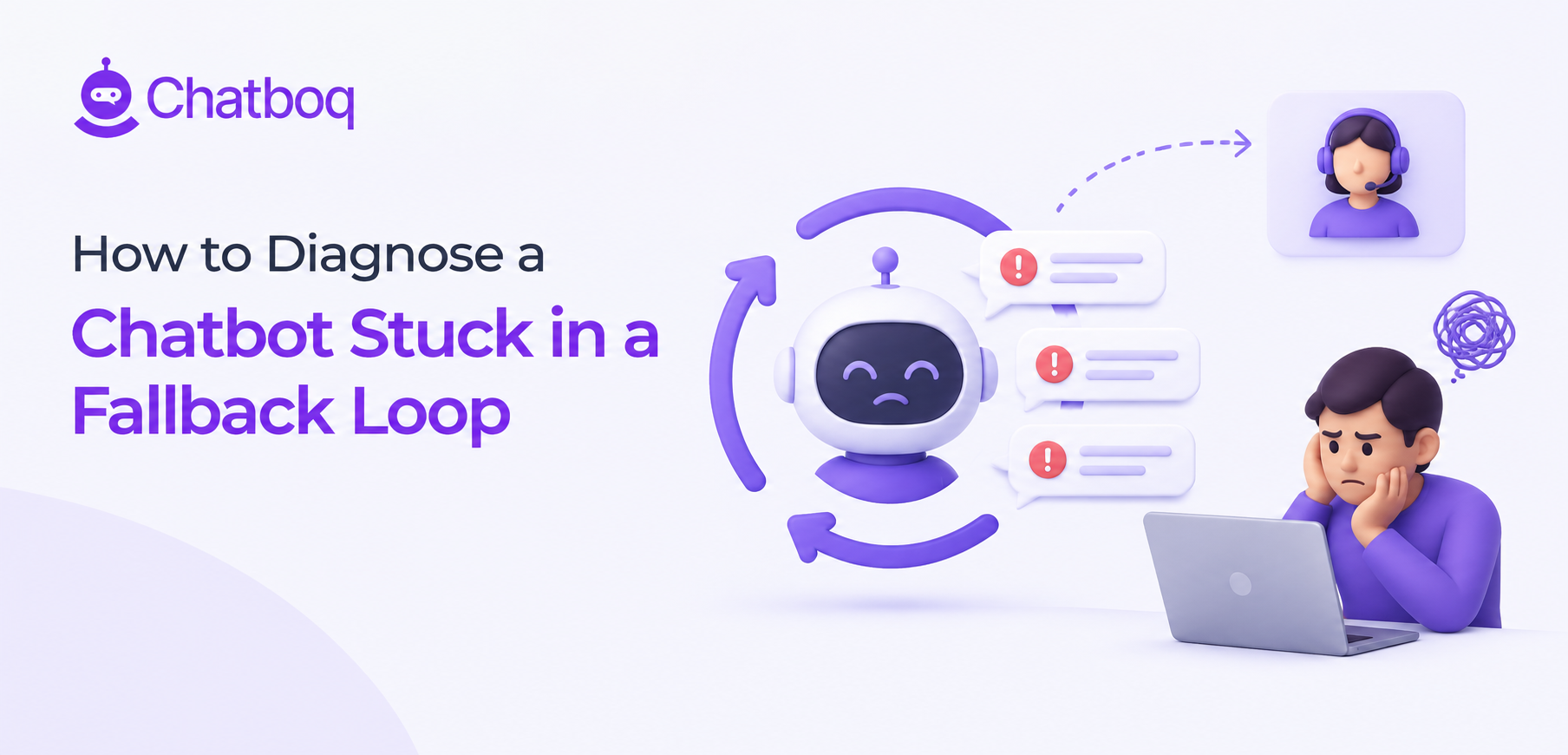
Loops are identifiable from conversation data before anyone reports them, using consecutive failure counts and repeated identical responses.
Consecutive failure counts
Filtering conversations by the number of fallbacks in a row surfaces loops directly, and two consecutive is enough to be worth reviewing.
This requires the platform to track consecutive rather than total failures, which is a common configuration gap.
Repeated identical responses
A conversation containing the same assistant message several times is looping regardless of whether those messages were fallbacks.
This catches loops in validation and disambiguation that fallback counting alone misses.
Unusually long conversations
Conversations far exceeding the expected depth for their flow are frequently loops, particularly when they end in abandonment rather than escalation.
Cross-referencing depth outliers with fallback counts identifies most looping conversations without reading anything.
Frustration language
Short repeated messages, capitalisation and explicit requests for a person all cluster in looping conversations and are worth alerting on in real time.
These are also the point at which the conversation should already have escalated, which makes their presence a configuration finding in itself.
Alerting in real time
Detecting a loop while it is happening allows an agent to intervene, which is considerably better than finding it in a report the following week.
Alerting on the second consecutive failure gives a team lead a chance to take over before the customer gives up.
 ChatGPT
 Perplexity
 Claude



Leave a Comment
Your email address will not be published. Required fields are marked *
By submitting, you agree to receive helpful messages from Chatboq about your request. We do not sell data.