
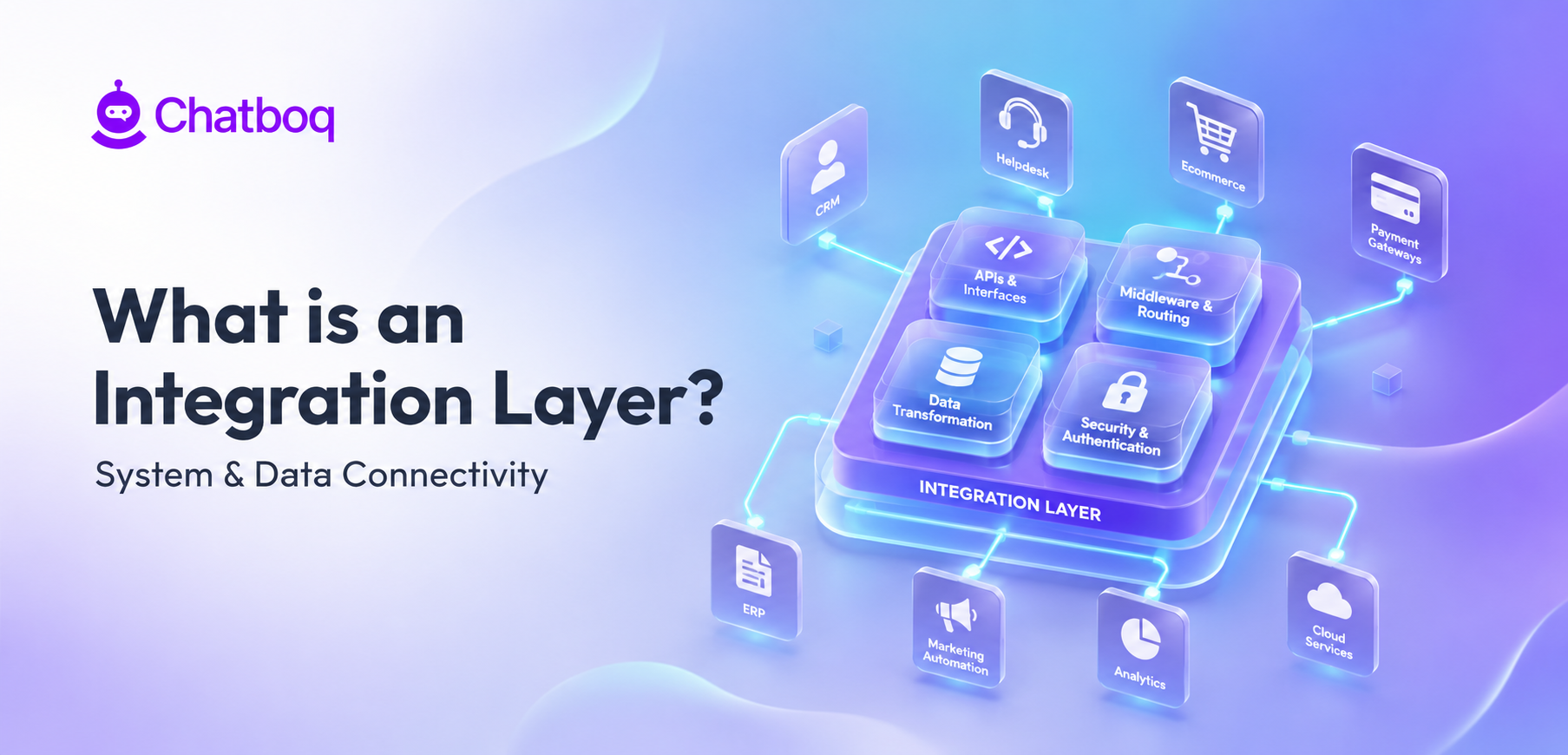
An integration layer is the operational connectivity framework that allows modern software ecosystems to function as a unified environment instead of isolated applications. Businesses use integration layers to automate workflows, synchronize data, and connect software systems across their operational stack.
Integration layers consist of 4 core components: APIs and communication interfaces, middleware and message routing systems, data transformation engines, and authentication and security management. Together these components enable real-time and asynchronous data synchronization across enterprise system stacks containing CRM platforms, helpdesk tools, ecommerce systems, payment gateways, ERP platforms, and marketing automation tools.
The integration layer differs from a direct API in scope. An API connects 2 systems for a specific purpose. An integration layer manages connectivity across 10, 50, or 200 systems simultaneously, adding orchestration logic, transformation rules, and operational intelligence around every data exchange. It differs from middleware in that middleware handles message transport and routing, while the integration layer governs what is transported, when it is transported, in what format, and how error handling is applied at each step.
Businesses use integration layers to eliminate manual data transfer, automate operational workflows, and maintain data consistency across all platforms without proportional increases in connection complexity as the system stack grows. Integration layers can introduce operational risks including API dependency failures, synchronization errors, and security vulnerabilities, which require monitoring, modular architecture design, standardized data formats, and strong authentication security to manage effectively across large-scale enterprise integration environments.
 ChatGPT
 Perplexity
 Claude


Leave a Comment
Your email address will not be published. Required fields are marked *
By submitting, you agree to receive helpful messages from Chatboq about your request. We do not sell data.