Based on the 2026 AI adoption trends across Asia, platforms like Chatboq stand to benefit significantly, but they will also face critical market challenges. Here’s a concise, insight-driven breakdown:
Opportunities for AI Chatbots like Chatboq
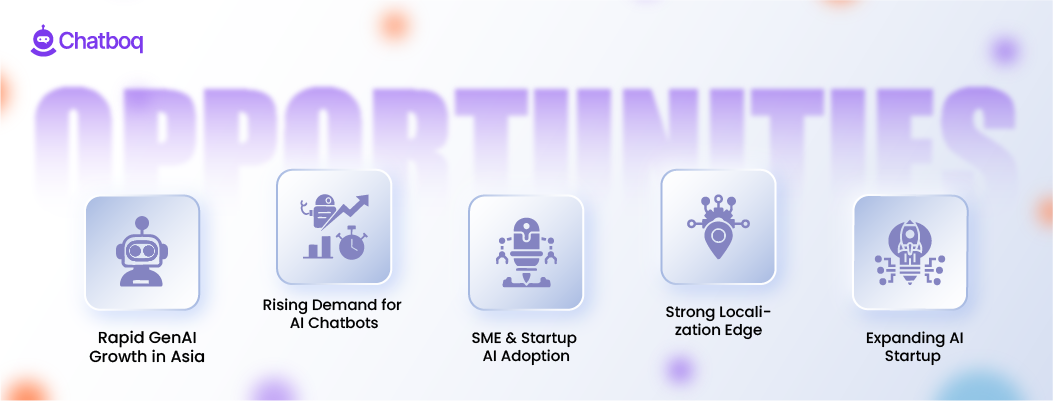
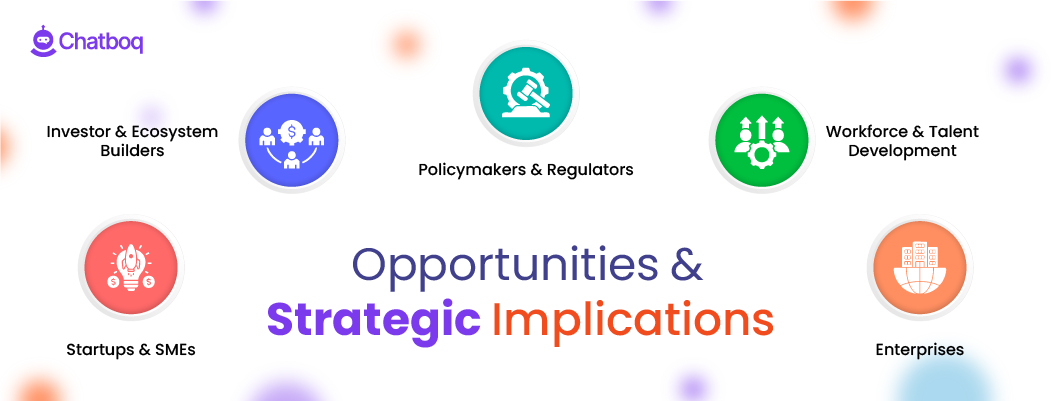
As AI adoption accelerates across Asia, driven by generative AI growth, enterprise digital transformation, and rising demand for automation, AI chatbots like Chatboq are uniquely positioned to benefit. The following opportunities highlight where Chatboq can gain the strongest foothold in the region:
1. Rapid Generative AI Adoption in Asia
With Asia’s generative AI market projected to reach USD 103.66 B by 2031, businesses are aggressively adopting AI-powered automation.
Opportunity:
Chatboq can position itself as a scalable, multilingual AI chatbot for Chinese, Indian, and Southeast Asian markets, especially for SMEs who prefer cloud-based, easy-to-deploy tools.
2. Surge in Enterprise Demand for AI Chatbots
40-50% of medium-to-large Asian enterprises are expected to implement AI chatbots by 2026.
Opportunity:
Chatboq can target enterprise workflows:
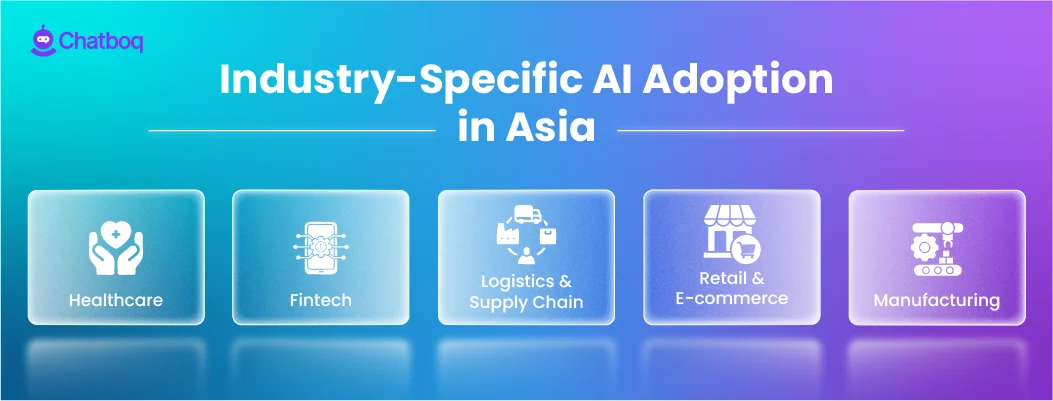
The demand is growing fast in sectors like fintech, retail, healthcare, logistics, all high-value segments for chatbot deployment.
3. AI Adoption Among SMEs & Startups
SMEs across Southeast Asia (Indonesia, Malaysia, Vietnam, Thailand) are accelerating adoption due to cloud affordability.
Opportunity:
Chatboq’s no-code/low-code setup can make it a preferred solution for SMEs that cannot afford custom AI development.
4. Localization Advantage
Asia’s linguistic diversity (Hindi, Bahasa, Vietnamese, Thai, Mandarin, Korean, Japanese) creates demand for localized AI tools.
Opportunity:
Chatboq can differentiate by offering:
-
Local language support
-
Cultural context handling
-
Regional customization
-
Industry-specific templates (fintech, e-commerce, healthcare, logistics)
5. Growing AI Startup Ecosystem
A 45% growth in AI startups (2023-2025) means more companies will integrate AI early.
Opportunity:
Chatboq can integrate with emerging Asian SaaS tools, becoming part of the region’s AI stack.
Challenges for AI Chatbots like Chatboq

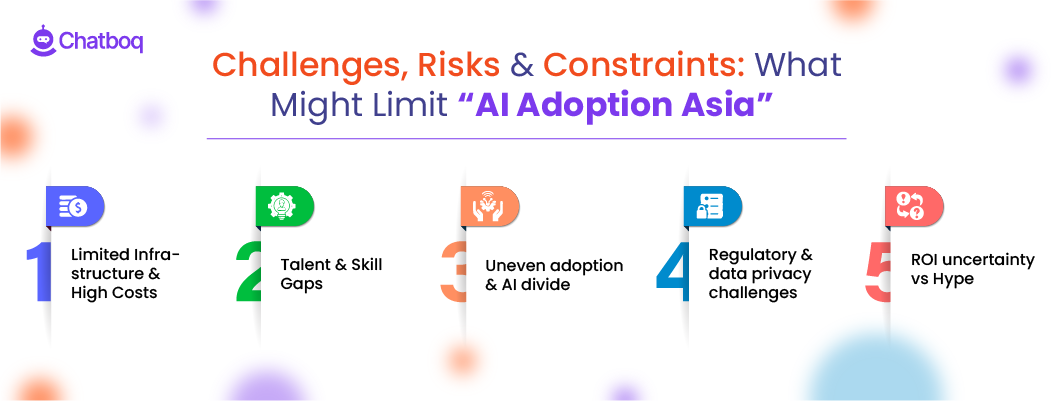
While Asia presents massive opportunities for AI chatbot adoption, the region also brings unique challenges that Chatboq must navigate to scale effectively. These hurdles span competition, regulation, infrastructure, and customer readiness, shaping how Chatboq positions itself in the Asian AI market:
1. Intense Competition
Asia is a high-growth market but also competitive, with players like:
Challenge:
Competing on price or raw features is difficult. Chatboq must differentiate on localization, ease of use, or niche specialization.
2. Regulatory Complexity
Asia’s regulations vary widely:
Challenge:
Chatboq must comply with multiple, fragmented regulatory frameworks, especially around data storage, PII handling, and transparency.
3. AI Talent Shortage in Asia
Many Asian markets suffer from high AI talent gaps.
Challenge:
Companies adopting Chatboq may lack teams who understand AI implementation, training, or optimization, increasing demand for Chatboq to provide managed AI services, onboarding support, and automation templates.
4. Uneven Infrastructure
While China, Japan, Singapore have strong infrastructure, parts of Southeast Asia experience cost/infrastructure constraints.
Challenge:
Chatboq needs lightweight deployment, low-latency cloud hosting, and possibly hybrid models for low-infrastructure environments.
5. Trust & ROI Uncertainty
Many Asian enterprises remain cautious with AI investment due to ROI uncertainty.
Challenge:
Chatboq must offer:
Without this, adoption may slow.


 ChatGPT
 Perplexity
 Claude




Leave a Comment
Your email address will not be published. Required fields are marked *
By submitting, you agree to receive helpful messages from Chatboq about your request. We do not sell data.