Customer service burnout produces measurable business costs through reduced support quality, accelerated employee turnover, FCR decline, institutional knowledge loss, and ticket backlog accumulation.
Increased Employee Turnover and Hiring Costs
Customer service roles have high turnover rates, often 30% to 45% annually in call centers. Replacing agents can cost 50% to 200% of annual salary. Burnout is a major driver of this turnover, making prevention a direct cost-saving strategy with measurable ROI.
Decline in First-Contact Resolution Rates
Burned-out agents show lower first-contact resolution because cognitive fatigue reduces diagnostic accuracy and resolution quality. They are more likely to close tickets prematurely to reduce workload, increasing reopen rates and total volume. This creates a feedback loop where lower FCR increases tickets, which increases burnout and further reduces resolution performance.
Loss of Institutional Knowledge in Support Teams
High burnout-driven turnover removes institutional knowledge about edge cases, escalation paths, and undocumented customer context held by experienced agents. When senior agents leave, resolution capability drops and takes months to rebuild. This is reflected in worsened ART and FCR. Capturing resolution logic in knowledge systems helps reduce loss if implemented before departures.
How to Prevent Customer Service Burnout (Core Strategies)
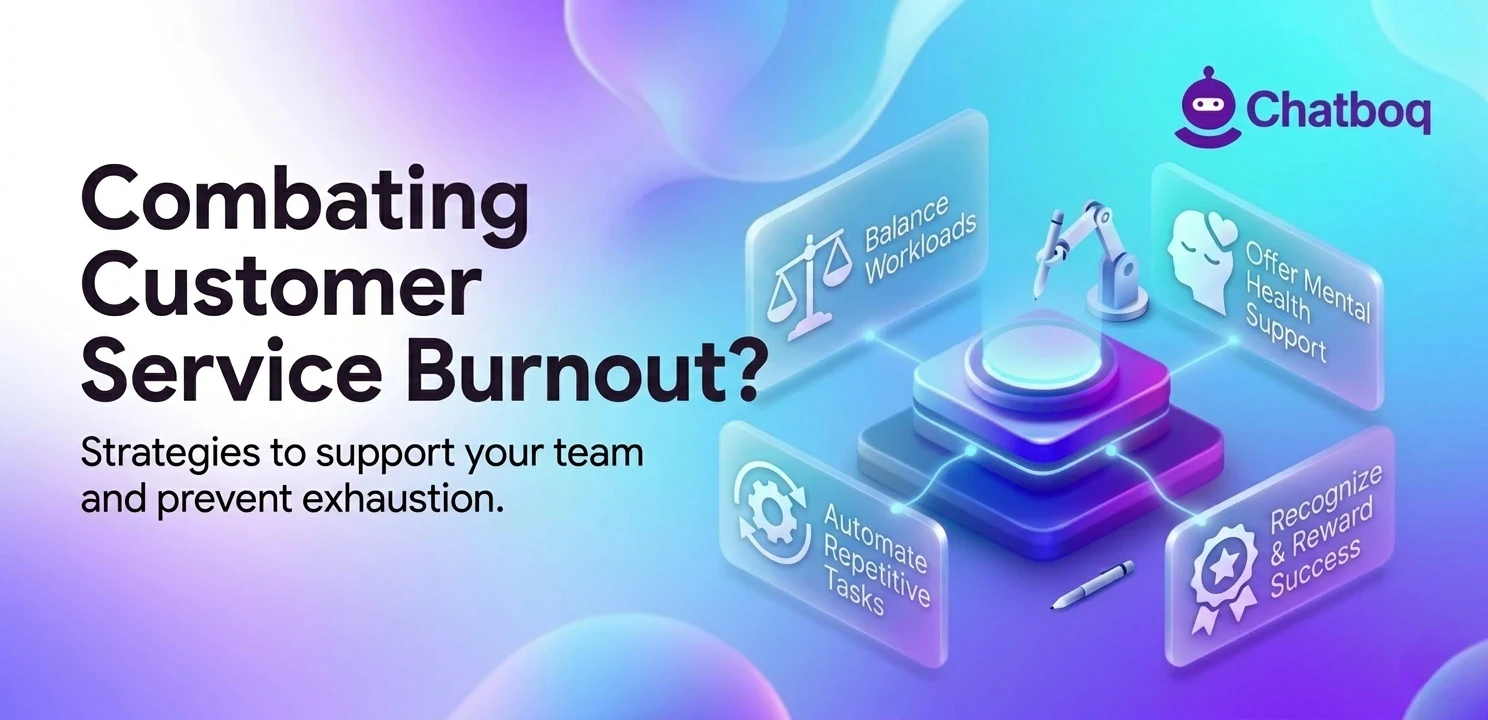
Customer service burnout is prevented by reducing workload through automation, defining clear escalation workflows, balancing ticket distribution, and using structured response frameworks that lower emotional and cognitive load on agents.
Reducing Workload Through Automation
First-line automation reduces burnout by deflecting repetitive queries before they reach agents. AI chatbots handle FAQs, order status, password resets, scheduling, and account lookups without human involvement. A 40% deflection rate cuts repetitive workload by 40%, leaving agents with more complex cases that require judgment and problem-solving rather than repetitive handling.
Improving Escalation Clarity and Workflow Structure
Defined escalation criteria reduce cognitive load by removing judgment calls during support interactions. Agents can escalate based on clear rules instead of evaluating each case independently, lowering stress and improving speed. Escalation SOPs with trigger conditions and routing paths standardize decisions, reducing overhead and improving consistency across teams at scale.
Creating Healthier Work Distribution Models
Workload caps that limit concurrent tickets per agent prevent the queue concentration where individual agents absorb disproportionate volume during peak periods. Intelligent routing systems in Freshdesk, Zendesk, and HubSpot Service Hub distribute tickets based on current queue depth rather than sequential assignment, preventing individual overload while maintaining overall throughput. Scheduled break enforcement between high-intensity interaction types gives agents cognitive recovery time that free-flowing queue assignment does not allow.
Training for Emotional Resilience and Communication Handling
Structured response frameworks reduce emotional regulation burden by providing predefined language for difficult interactions. Agents no longer need to compose responses while managing emotional control simultaneously. Instead, de-escalation scripts shift effort from composition to execution, lowering cognitive load and improving consistency. This is structured support, not rigid scripting or constraint.

 ChatGPT
 Perplexity
 Claude


Leave a Comment
Your email address will not be published. Required fields are marked *
By submitting, you agree to receive helpful messages from Chatboq about your request. We do not sell data.