
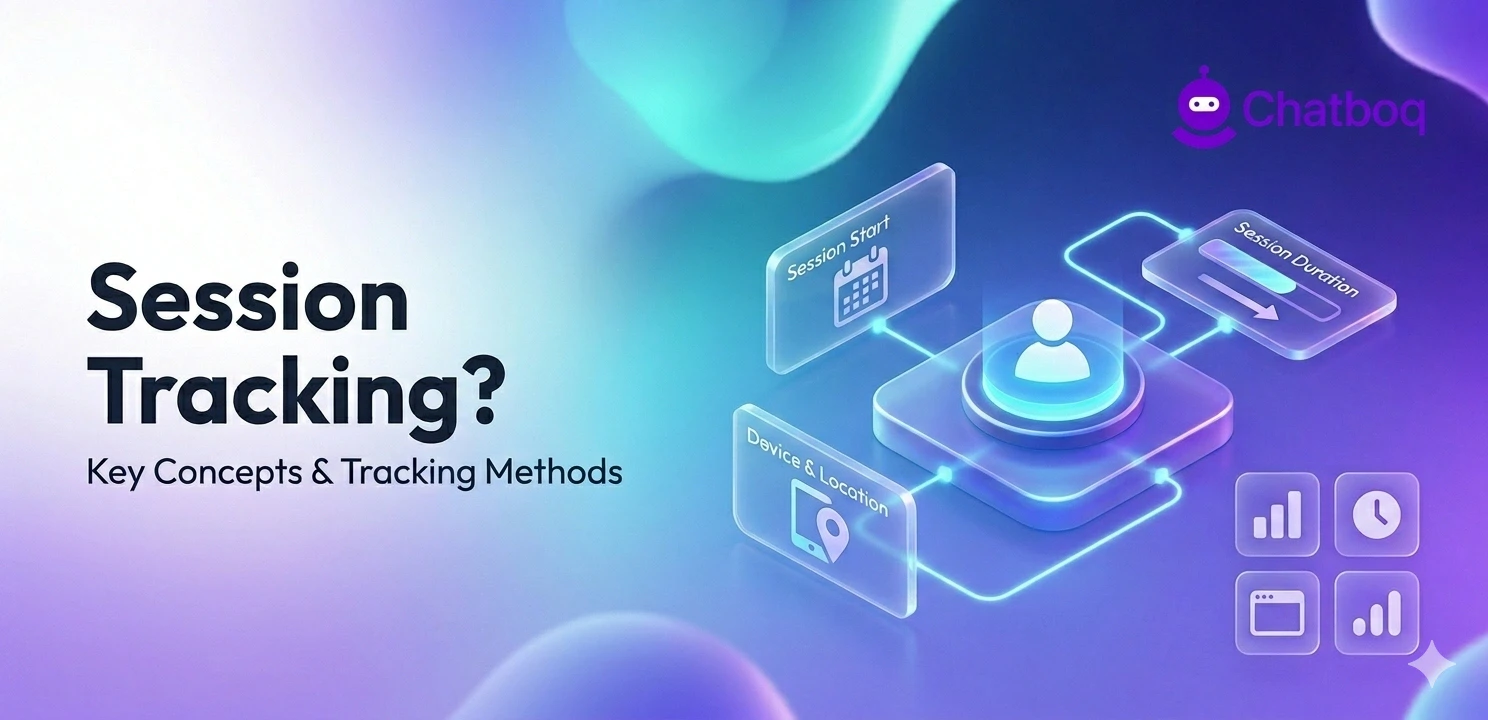
Session tracking is a behavioral data system that captures how users interact with digital products across defined engagement periods, translating clicks, navigation paths, session activity, and conversational behavior into structured analytics for customer experience and conversion optimization.It functions as a core behavioral analytics layer that connects raw interaction events into complete customer journey sequences.
Businesses use session tracking to understand how users move through websites, applications, and support environments, revealing friction points, drop-off stages, conversion pathways, and engagement depth across entire customer journeys. These engagement analytics insights are used to improve UX design, optimize funnels, personalize interactions, and support data-driven decision-making across product, marketing, and customer service operations.
Modern session tracking systems rely on session IDs, event tracking scripts, clickstream monitoring, and real-time behavioral pipelines to record meaningful interactions such as clicks, scroll behavior, page transitions, form inputs, and chat engagement signals. These events are processed through analytics pipelines, APIs, and tracking frameworks that reconstruct user behavior into structured session-level intelligence.
Modern systems extend beyond basic tracking by integrating real-time session data into live chat platforms, AI-driven analytics engines, and automation workflows that trigger personalized engagement based on user behavior signals. As a result, session tracking functions not only as an analytical system but also as a real-time decisioning layer for conversion optimization, support efficiency, and customer experience enhancement.
 ChatGPT
 Perplexity
 Claude


Leave a Comment
Your email address will not be published. Required fields are marked *
By submitting, you agree to receive helpful messages from Chatboq about your request. We do not sell data.