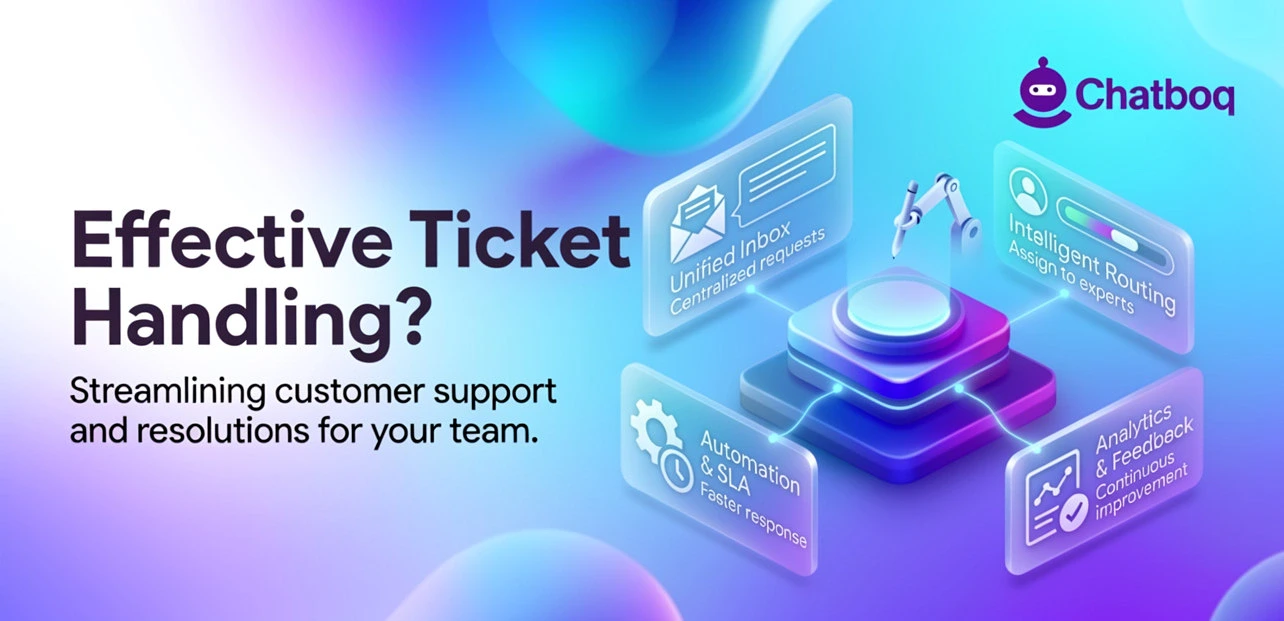
Effective ticket handling relies on fast ownership assignment, standardized categorization, clear escalation paths, and impact-based prioritization. Maintaining full cross-channel context, reducing handoffs, using personalized templates, enforcing customer-confirmed closure, and resolving recurring issues at the root level improve speed, quality, and long-term ticket volume.
Assign Clear Ownership at the Moment of Ticket Creation
Every ticket must have a named owner within 5 minutes of creation. Ownership assignment is the single most effective intervention for preventing the accountability gap that produces missed tickets and internal bouncing. Automated routing systems assign ownership at ticket creation without supervisor review for the majority of standard tickets. Escalated or unusual tickets require supervisor assignment within the same 5-minute window. Tickets that remain unowned for longer than 5 minutes during business hours trigger automated supervisor alerts.
Standardize Categorization to Avoid Inconsistent Routing
A categorization taxonomy with 3 to 4 levels (category, sub-category, product area, and issue type) provides sufficient routing specificity without creating a taxonomy so granular that agents make inconsistent choices across the same issue type. Inconsistent categorization produces inconsistent routing, which produces inconsistent resolution quality and makes ticket volume data unreliable for trend analysis. Taxonomies should be reviewed quarterly: categories with very high or very low volume indicate routing definitions that need adjustment.
Define Escalation Paths Before Incidents Occur
Escalation paths defined before incidents occur produce faster escalations with less context loss than escalations improvised during high-stress incident situations. Pre-defined escalation paths specify: the trigger conditions that qualify a ticket for escalation (SLA breach threshold, customer tier, issue severity, technical complexity beyond Tier 1 authority), the target team or individual for the escalation, the required context that must accompany the escalation (prior steps taken, customer communication sent, diagnostic data collected), and the maximum escalation response time.
Prioritize Based on Business Impact, Not Just Urgency
Business impact prioritization assigns higher queue position to tickets affecting more customers, generating more revenue risk, or triggering compliance obligations, regardless of whether the customer reporting them expresses urgency loudly. A technically-phrased, calmly-written ticket from an enterprise customer reporting a data access issue affecting 50 users is higher priority than an emotionally-written ticket from an individual user reporting a cosmetic display problem, even if the latter ticket generates more follow-up contacts. Impact-based prioritization requires clear criteria that agents apply consistently rather than responding to customer frustration intensity.
Maintain Full Customer Context Across All Channels
Channel context maintenance requires that every agent handling a ticket can access all prior contacts from the same customer regardless of channel. CRM integration that links tickets to customer accounts enables this. Omnichannel inbox platforms (Respond.io, Zendesk) that consolidate channel history into a single thread provide this natively. Without cross-channel context, agents ask customers to repeat information they provided in prior contacts, which is the most consistently cited driver of customer frustration in support interactions according to Zendesk's Customer Experience Trends reports.
Reduce Internal Handoffs Through Structured Workflows
Each internal handoff between agents or teams adds an average of 2 to 4 hours to ticket resolution time and increases the probability of context loss that requires the customer to re-explain the issue. Structured workflows reduce handoffs by defining, at ticket creation, which team has resolution authority for each ticket category, and routing directly to that team rather than through intermediate triage layers. Tickets that require multi-team input should use collaboration features (internal notes, @mentions) rather than reassignment to prevent ownership gaps during collaboration.
Use Templates but Allow Contextual Personalization
Response templates reduce composition time for common inquiry types from 3 to 5 minutes per reply to under 60 seconds for suggestions requiring minor personalization. Templates without personalization produce responses that customers recognize as scripted, reducing trust and increasing reopen rates for customers who feel their specific situation was not addressed. Effective template usage requires that agents adapt templates to the specific customer's situation rather than sending verbatim template text. Template adoption rate (percentage of responses using templates) and template acceptance rate (percentage of templated responses that receive positive CSAT) together indicate whether templates are improving quality or reducing it.
Close Tickets with Explicit Customer Confirmation
Tickets should close on explicit customer confirmation or on reasonable implied confirmation (no customer response within 72 hours after a resolution that successfully addressed the described issue). Tickets should not close because an agent has sent a response, because a defined time period has elapsed without follow-up, or because the issue appears resolved from the operational side without customer awareness. Teams that measure first-contact resolution rates from agent-declared resolution rather than customer-confirmed resolution consistently report higher FCR metrics than teams measuring from customer confirmation, but their actual reopen rates and customer satisfaction scores are lower.
Track Recurring Issues Instead of Repeatedly Resolving Them
Any ticket category generating more than 50 individual tickets per month on the same underlying issue represents a systemic problem requiring a systemic solution, not 50 individual resolutions. Tracking recurring issue categories, identifying their root causes, and escalating them to product, operations, or content teams for root cause resolution reduces the next month's ticket volume in that category by 30 to 80%. Teams that resolve recurring issue tickets individually without tracking the pattern maintain the same ticket volume indefinitely while continuously investing resolution capacity in avoidable work.
Why Fast Response Is Not Enough
First response time is the metric most commonly tracked and optimized in support operations. It is also the metric most frequently optimized at the expense of the metrics that actually predict customer retention. A first response within 1 hour that acknowledges the ticket without providing useful resolution information produces faster acknowledgment but slower actual resolution. Teams optimizing for fast response often reduce response quality in the process, increasing reopen rates and creating more total contacts per resolution than slower but higher-quality first responses would have generated.

 ChatGPT
 Perplexity
 Claude



Leave a Comment
Your email address will not be published. Required fields are marked *
By submitting, you agree to receive helpful messages from Chatboq about your request. We do not sell data.