
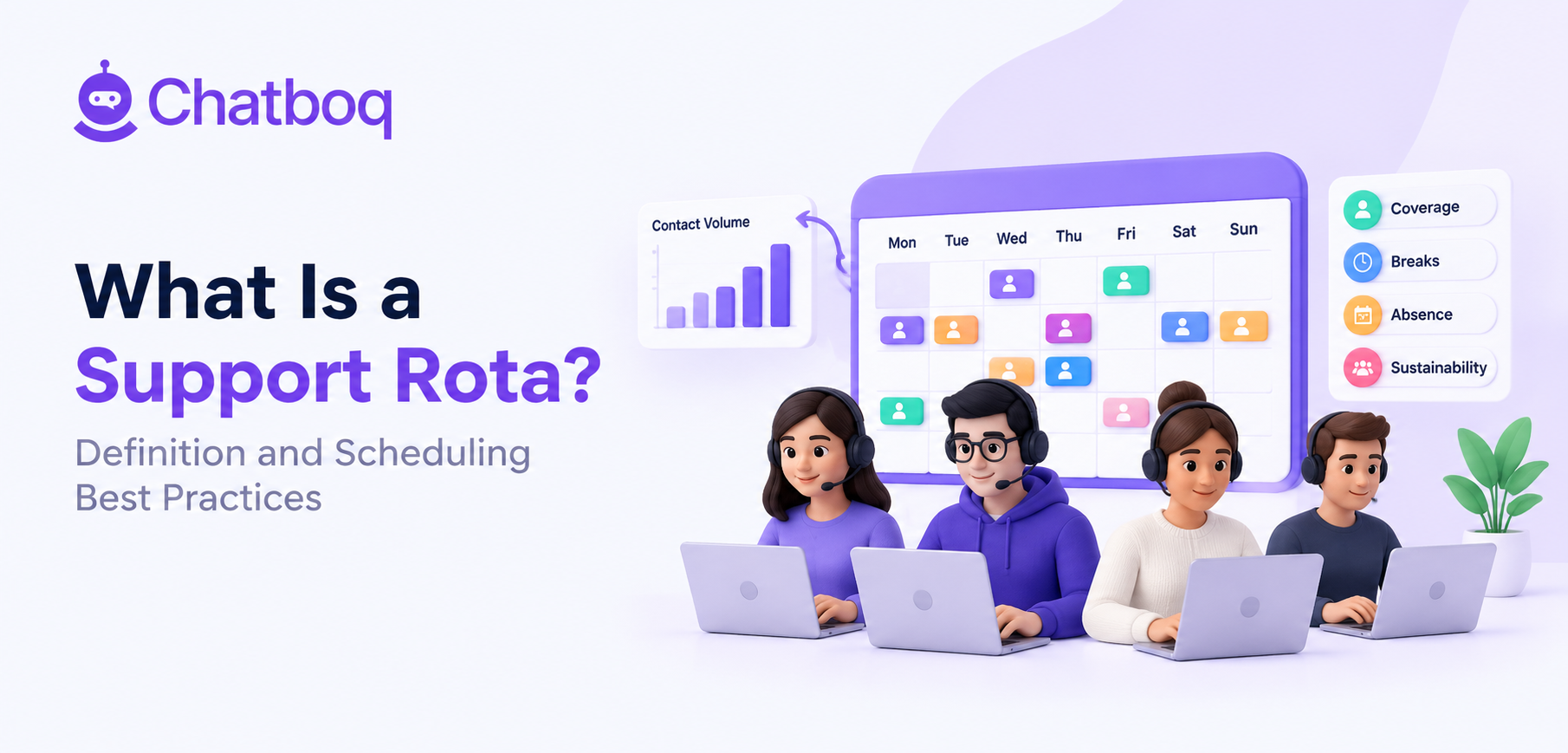
A workable rota covers demand by hour, handling capacity, breaks and non-productive time, absence, and the hours staff can sustain.
Demand by hour
Contact volume varies substantially through the day and week, and a rota built on daily totals will be short at peak and idle at trough.
Plotting arrivals by hour and weekday is the first input and frequently contradicts assumptions about when the team is busiest.
Capacity per person
How much one agent can handle depends on channel, concurrency and complexity, and using an optimistic figure produces a rota that fails at peak.
Observed effective concurrency rather than the configured limit is the honest number to plan with.
Shrinkage
Breaks, training, meetings, absence and administrative time consume a substantial proportion of paid hours, and plans built on nominal headcount fall short daily.
Applying a realistic shrinkage factor is unglamorous and is the difference between a rota that holds and one that does not.
Absence and cover
Every rota needs a defined answer for what happens when someone is absent, since improvising it each time produces uncovered periods.
This is more acute in small teams, where one absence can remove an entire shift's coverage.
 ChatGPT
 Perplexity
 Claude







Leave a Comment
Your email address will not be published. Required fields are marked *
By submitting, you agree to receive helpful messages from Chatboq about your request. We do not sell data.