
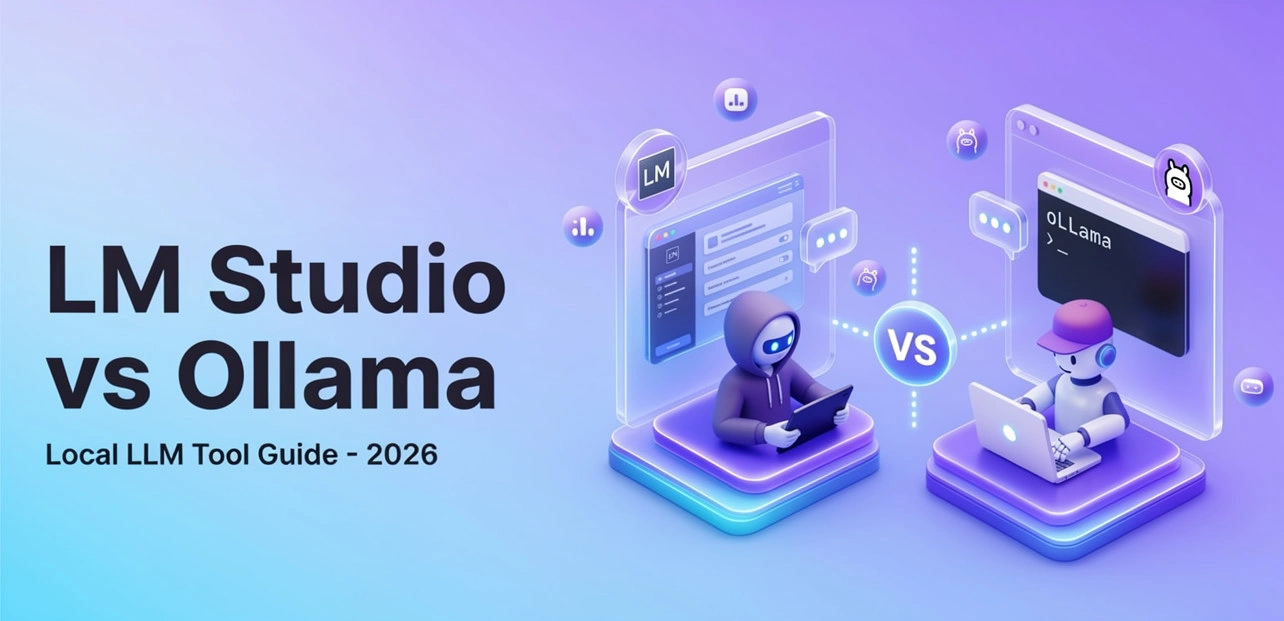
LM Studio and Ollama are the two most widely used tools for running large language models locally in 2026, but they operate at different layers of the local LLM stack and serve different user needs. LM Studio is a GUI desktop application for model exploration, prompt testing, and offline chat. Ollama is a CLI-based LLM runtime that serves models through a persistent REST API at localhost:11434, functioning as a local replacement for the OpenAI API.
Both tools use llama.cpp as their underlying inference engine, support GGUF quantized models, and provide OpenAI-compatible API endpoints. The differences are architectural: LM Studio is an exploration layer built for human-in-the-loop model evaluation, Ollama is an infrastructure layer built for programmatic model access and application integration. LM Studio integrates a Hugging Face model browser for broad model discovery. Ollama integrates natively with LangChain, AnythingLLM, and any framework that accepts an HTTP API endpoint.
In practice, many users end up running both tools in 2026 because they serve different parts of the workflow. LM Studio handles model selection, prompt engineering, and parameter experimentation. Ollama handles application development, automation workflows, and production API serving. This separation keeps experimentation isolated from deployment and matches the workflow of developers building on local LLMs.
 ChatGPT
 Perplexity
 Claude




Leave a Comment
Your email address will not be published. Required fields are marked *
By submitting, you agree to receive helpful messages from Chatboq about your request. We do not sell data.